Six precision-engineered tools that take any deal from raw lead to signed LOI — in minutes, not months. Built on the CPA methodology. Trusted by investors from first deal to full portfolio.
From sourcing motivated sellers to submitting a structured offer — every stage of the CPA deal process is automated and interactive.
Free
01 / 06
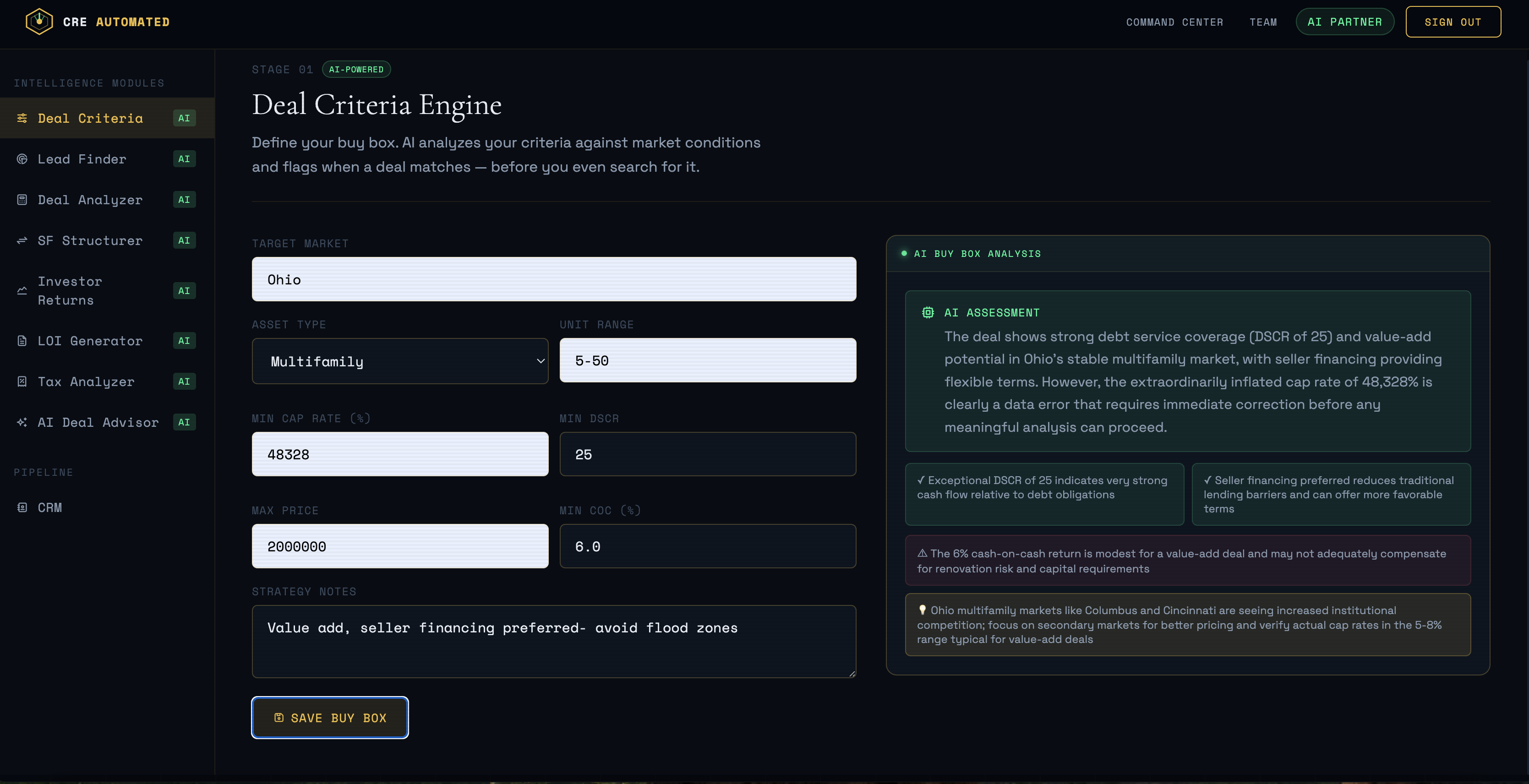
Deal Criteria Engine
Set your property type, market, price range, and minimum financial thresholds. Your filter for every lead that enters the pipeline.
Interactive · 8 filters
02 / 06
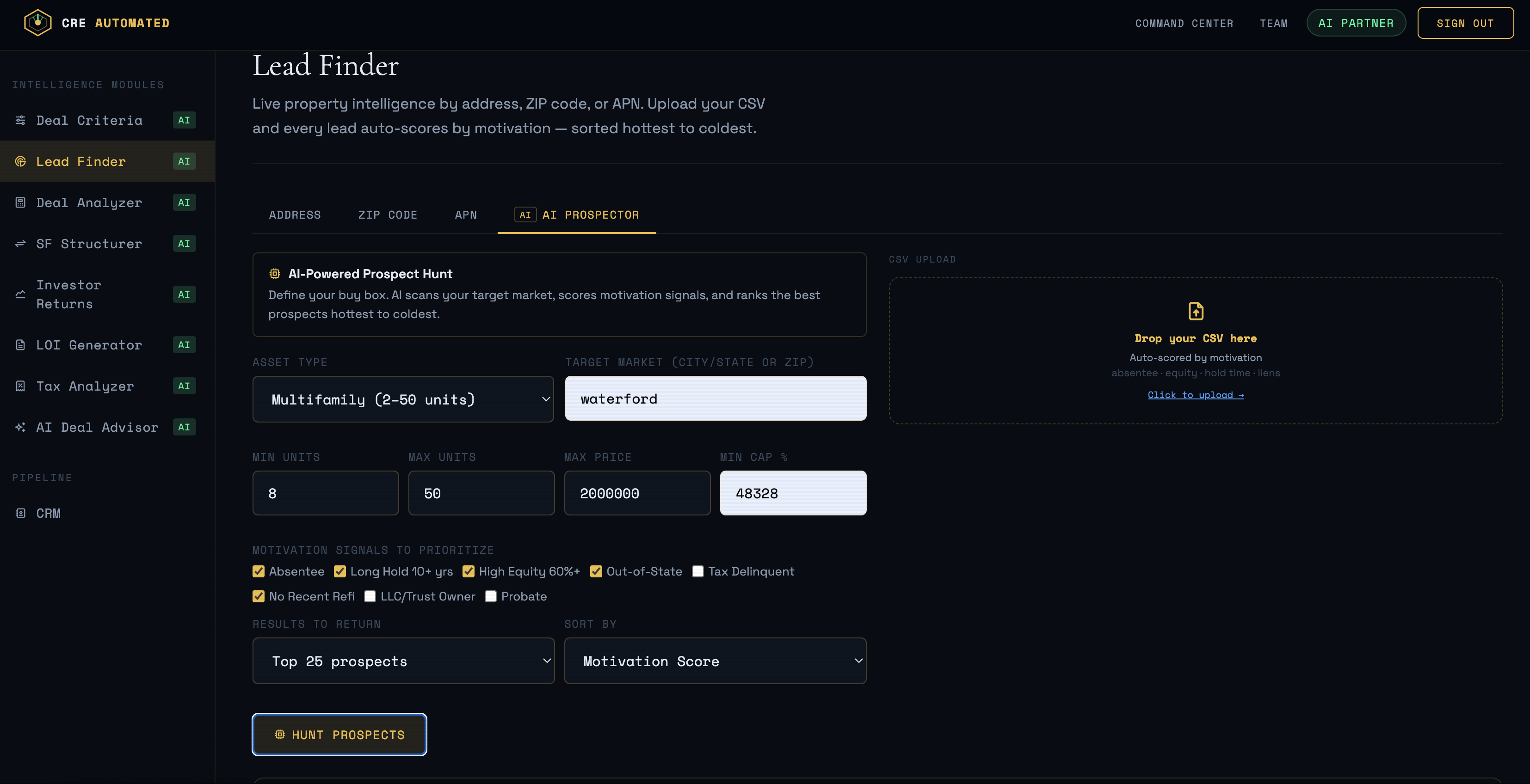
Lead Finder
Motivated seller signals, county record sourcing, broker pipeline, and skip-trace workflows. Find deals before they hit the market.
Scripts · Templates · Automation
Free
03 / 06
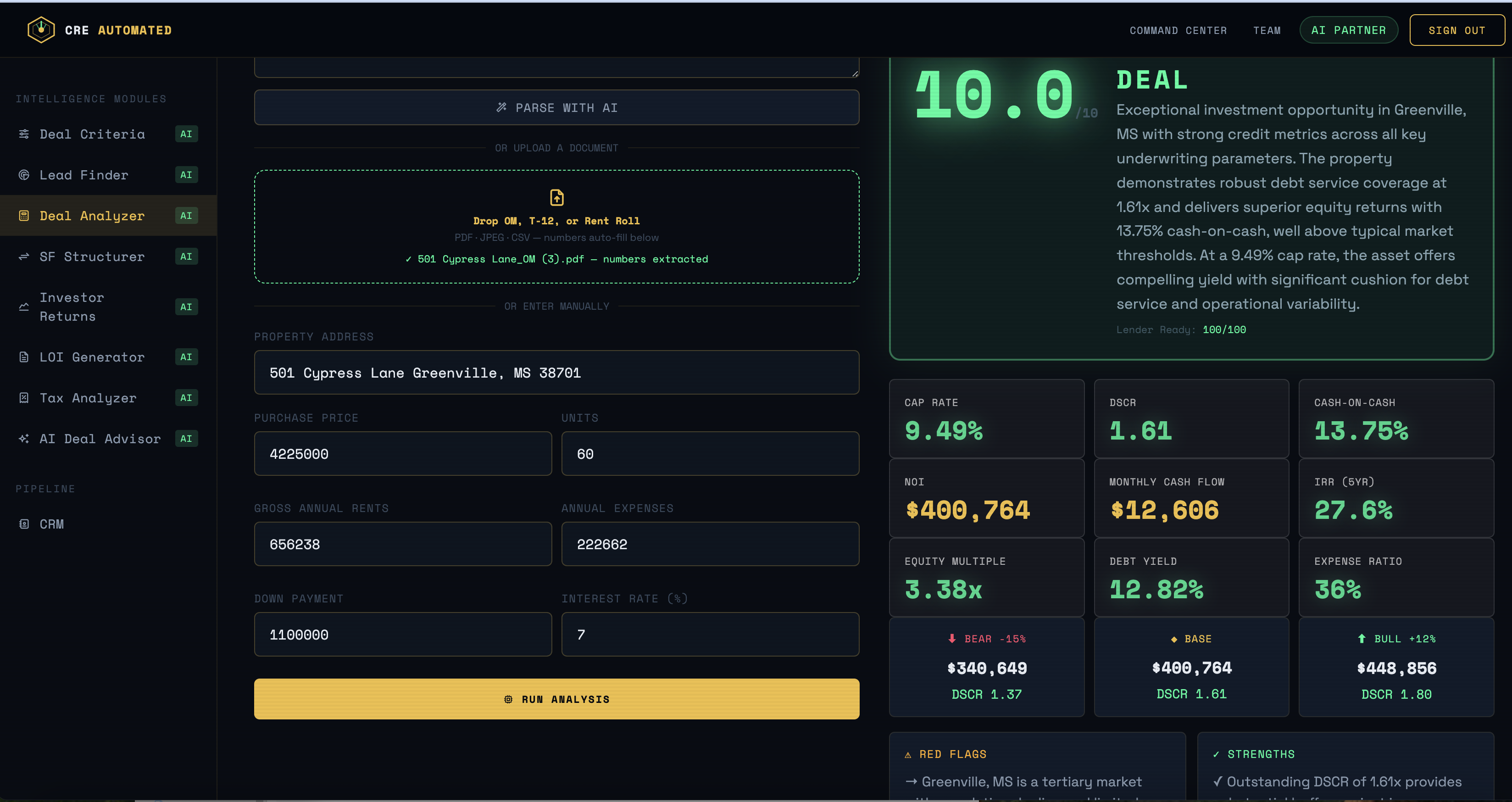
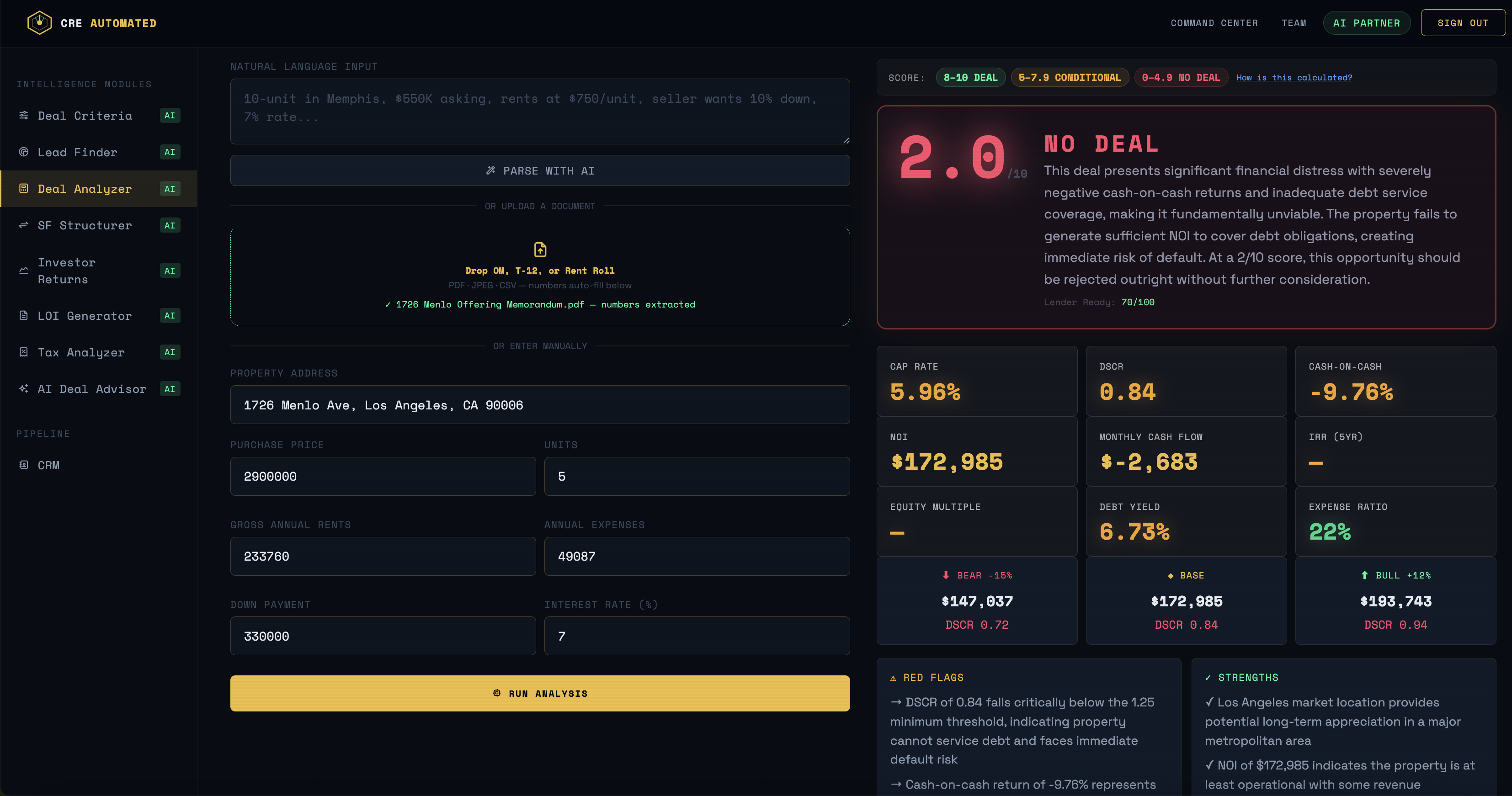
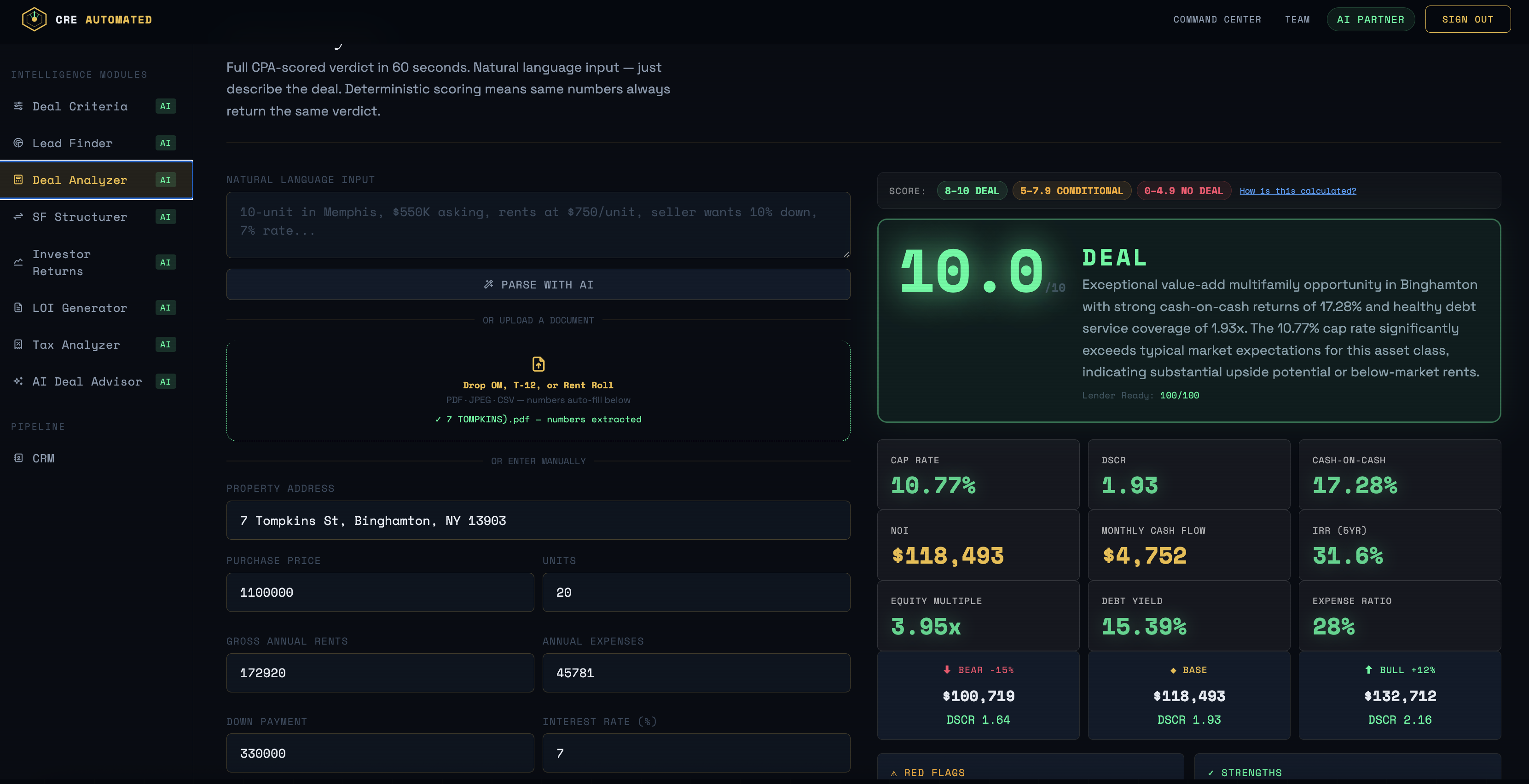
Deal Analyzer
Live NOI, dual cap rates, GRM, cash-on-cash, DSCR, and a weighted go/no-go score. 5–50 unit version free · 51–2,000 unit version Pro+.
Real-time · Two versions
04 / 06
Seller Financing Structurer
Model the win-win carry-back note. Seller tax benefit calculator, SF vs conventional comparison, and four structure types.
IRC §453 · Win-win
05 / 06
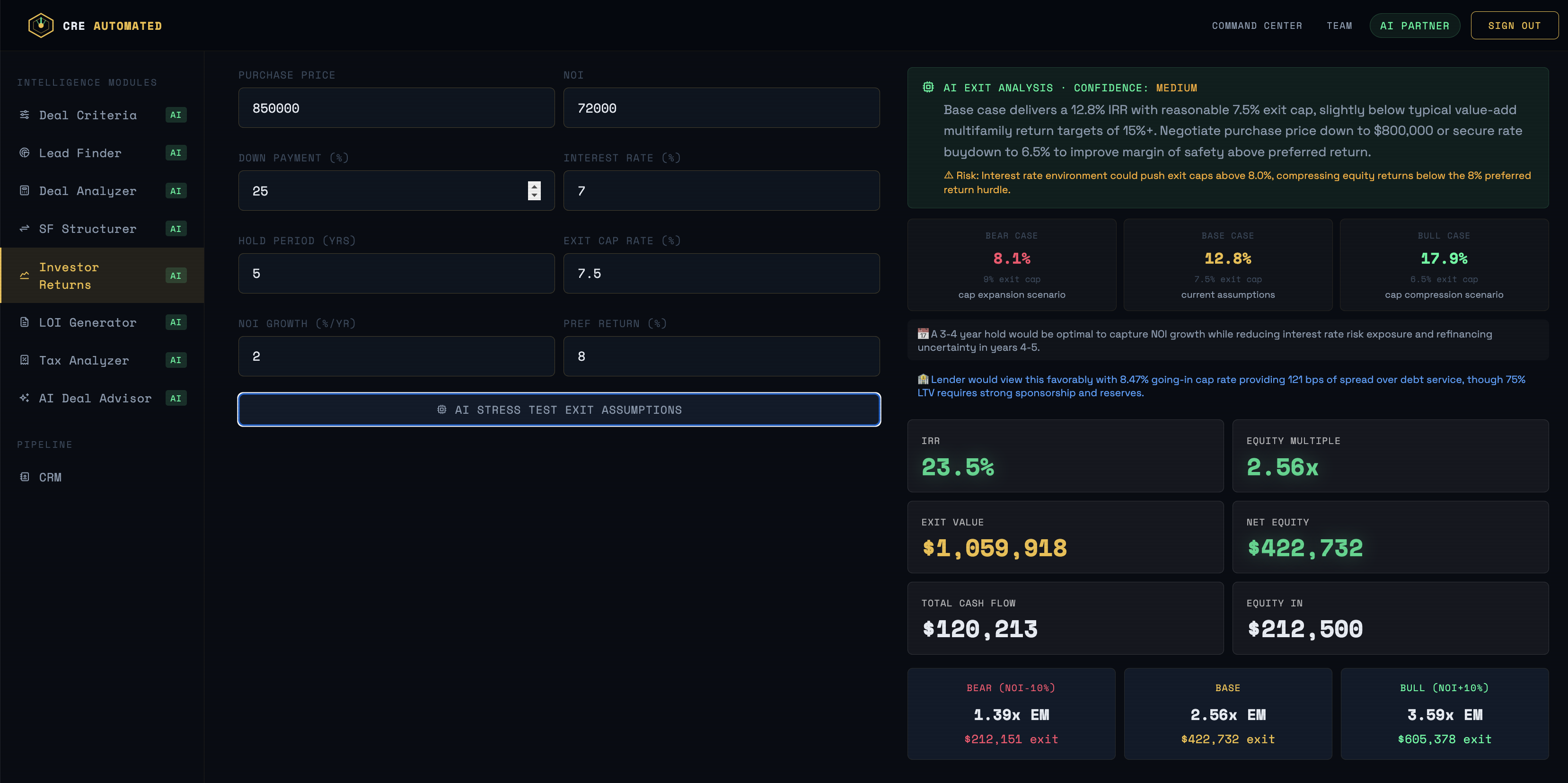
Investor Returns
IRR, equity multiple, preferred return, LP/GP waterfall, 5-year pro forma, and a bear/base/bull stress test with a one-page investor pitch.
IRR · Waterfall · Scenarios
06 / 06
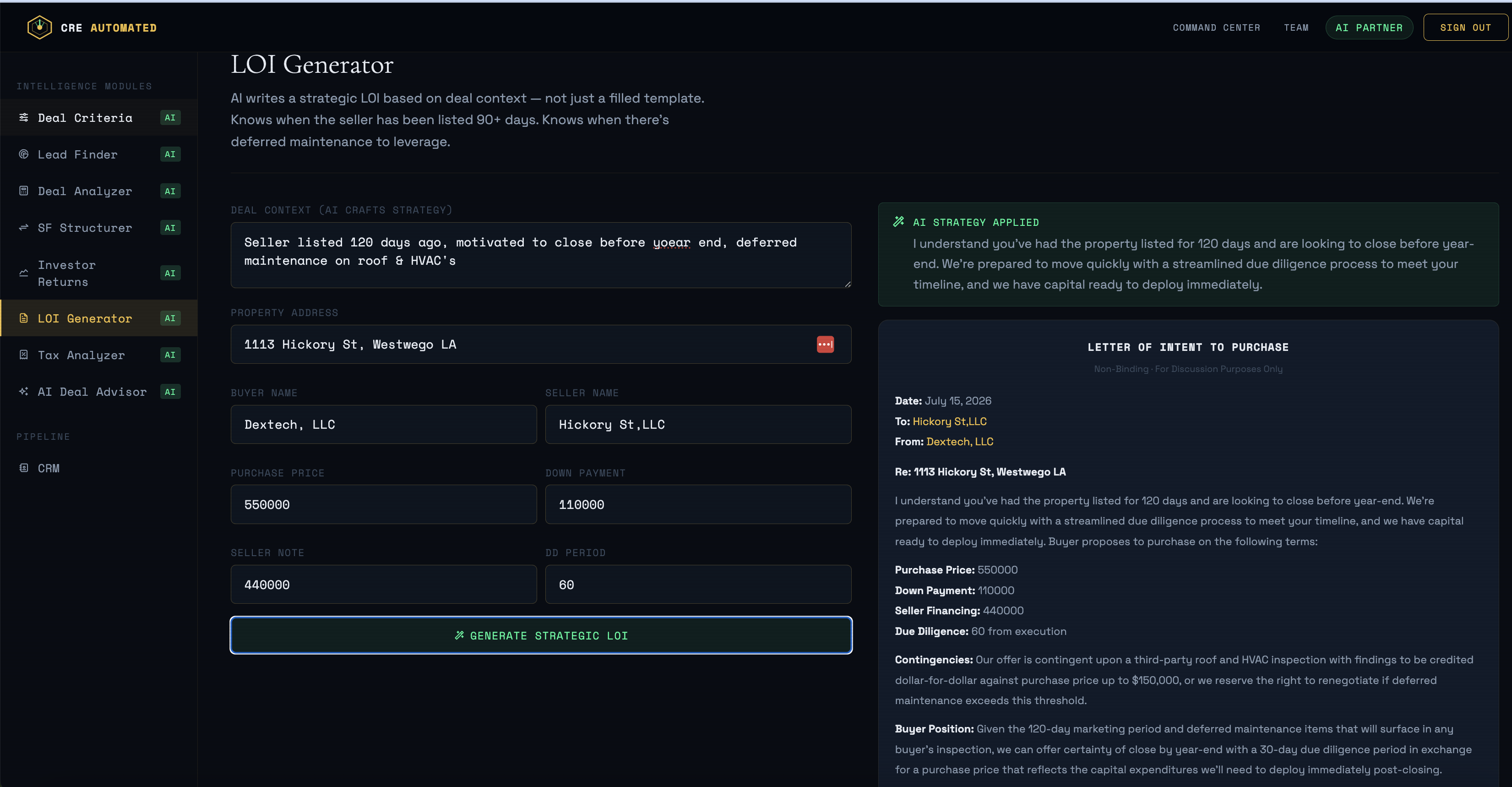
LOI Generator
Live-editable Letter of Intent with 4 standard contingencies, 30-day due diligence checklist, deal timeline, and seller negotiation scripts.
4 contingencies · Ready to send
Why CRE Automated
Built for the investor to close deals.
Real-time calculations
Every slider update recalculates NOI, cap rates, IRR, and cash flow instantly. No spreadsheets, no formulas.
CPA methodology built-in
Peter Harris's commercial investing framework is encoded into every tool — from deal criteria to offer structure.
Institutional standards
Debt yield, DSCR, cap spread, value-add underwriting — the same metrics used by professional fund managers.
Investor-ready outputs
The Stage 5 waterfall and pitch summary are formatted to present directly to LP investors.
CRE Automated · Investor Dashboard
Your deal machine
Stage 1 and Stage 3 are available free. Subscribe to unlock the full pipeline — from lead to LOI.
Stage 01 · Free
Deal Criteria Engine
Define your investment filters. Every lead that enters your pipeline is measured against these thresholds.
Financial thresholds
Min cap rate6.5%
Min cash-on-cash return8.0%
Min monthly cash flow$500
Max vacancy assumption10%
Max down payment %20%
Deal size
Min purchase price$300K
Max purchase price$2M
Min units5
Max units50
CPA rule: The 5–20 unit sweet spot sits below institutional radar and above individual buyer competition — the perfect zone for seller financing and below-market acquisitions.
Stage 03B · Pro+
Advanced Deal Analyzer 51–2,000 units
Institutional-grade underwriting — itemized expenses, CapEx reserves, debt yield, value-add NOI, stress testing, and 5-year hold model.
Advanced 51–2,000 unit analyzer
Debt yield · CapEx reserves · Value-add NOI · Bear/base/bull stress test · IRR projection · Institutional-grade 9-metric go/no-go score
Enter your target returns. The calculator solves backwards — showing the maximum price you can pay to hit every threshold simultaneously.
Your targets
Target cash-on-cash10.0%
Target monthly cash flow$1,000/mo
Target DSCR1.30
Annual NOI$72,000
Down payment %10%
Interest rate6.00%
Amortization25 yrs
Maximum offer prices
—
Max price (CoC)
—
Max price (CF)
—
Max price (DSCR)
—
Recommended max offer price
How it works: Each constraint implies a different price ceiling. The recommended offer is the lowest of the three — the price that satisfies all targets simultaneously.
Side-by-side deal comparison
Pro+ · $199/mo
Enter two deals and compare every metric head to head. The stronger deal is highlighted automatically.
Deal A
Asking price$850,000
Units10
Monthly rent/unit$1,200
Vacancy %8%
Expense ratio %45%
Down %10%
Interest rate6.00%
Deal B
Asking price$1,100,000
Units14
Monthly rent/unit$1,350
Vacancy %10%
Expense ratio %47%
Down %15%
Interest rate6.50%
Deal A results
Deal B results
Stage 04 · Analyst+
Seller Financing Structurer
Model the carry-back note, compare SF vs conventional, calculate seller tax benefit, and handle objections.
Seller financing terms
Purchase price$850,000
Annual NOI$72,000
Down payment %10%
CPA target: 10–15%
Carry note interest rate6.00%
Amortization25 years
Balloon in5 years
Calculated deal metrics
Down payment
—
Carry note
—
Monthly payment
—
Annual debt service
—
Annual cash flow
—
Cash-on-cash
—
DSCR—
LTV—
Balloon balance due—
Total interest to seller—
CPA win-win: Seller earns monthly income + interest. You control a cash-flowing asset with minimal capital. No bank required.
Seller financing vs conventional — 25% down at 7.5%
Conventional loan
Down payment—
Interest rate7.50%
Monthly payment—
Annual cash flow—
Cash-on-cash—
DSCR—
Seller financing
Down payment—
Interest rate—
Monthly payment—
Annual cash flow—
Cash-on-cash—
DSCR—
Note value calculator Pro+ · $199/mo
If the seller ever wants to sell their carry-back note to a note buyer, what is it worth today? Shows the seller a concrete secondary exit option — strengthening the seller financing pitch.
Note terms
Original note amount$765,000
Note interest rate6.00%
Remaining term (years)5 years
Current balance owed$720,000
Note buyer's yield target12%
Note buyers typically price at 10–14% yield
LTV on collateral80%
Note buyer's security — lower LTV = more valuable note
Note valuation
—
Face value (balance owed)
—
Note market value
—
Discount to face
—
Seller cash today
Pitch line for seller: "If you ever need to access your capital before the balloon date, you can sell this note to an investor for approximately $X — giving you an immediate lump sum without waiting."
Seller objection simulator Pro+ · $199/mo
Click any objection to reveal the exact response — word for word. Counters drawn from the CPA methodology and real seller conversations.
"I just want all cash. I don't want to wait for my money."
TaxIncome
"I completely understand — and I respect that. Here's one thing worth knowing: in year one of a cash sale, you'd pay capital gains tax on your entire profit at once. With seller financing, you only pay tax as you receive payments — the IRS calls it an installment sale under Section 453.
You still get a significant down payment at closing — cash in hand immediately. Then monthly payments just like a pension for the next 5 years. Many sellers find that's actually more secure than a lump sum they have to reinvest in a low-rate environment.
If you truly need all cash immediately, I understand completely — and we can restructure. But most owners in your position end up keeping more after tax with this approach."
📊 Have the seller tax benefit calculator ready — show them the exact numbers.
"What if you stop paying me?"
Security
"Great question — and the honest answer is you're in a stronger position than most banks.
The note is secured by the property itself, recorded as a lien at closing. If I ever default, you don't just lose your money — you get the property back. And you keep every payment I've already made to you.
This is documented by a real estate attorney, with a promissory note and deed of trust on file at the county. You're fully protected by the collateral. Would you like to speak with my attorney to walk through the documents?"
📋 Schedule a 3-way call: you, the seller, and your RE attorney. Transparency eliminates this objection permanently.
"My financial advisor said I should just sell outright."
TaxTrust
"I'd encourage you to share the installment sale structure with your advisor specifically — it's governed by IRS Section 453, and many financial advisors aren't deeply familiar with real estate tax implications versus securities.
What I'd suggest: let me put together a one-page side-by-side — cash sale net versus seller financing net over 5 years. You share it with your advisor, they review the numbers, and you make an informed decision together. That way you're not taking my word for it — you're seeing the math."
📄 Offer to produce the one-pager immediately using the seller tax benefit calculator.
"I think I can get more money on the open market."
Value
"You absolutely might — and I respect that. Here's the comparison I'd invite you to consider:
If you list with a broker: 3–6 months on market, 5–6% commission, 90-day close, capital gains tax on the full amount year one.
With me: close in 30–45 days, no commission, capital gains spread over 5 years, and monthly income in the meantime.
Even if another buyer pays $20,000 more, by the time you subtract commission and tax, you may net less than my offer on the same-day timeline. Would you be open to running those numbers together?"
🧮 Run the comparison in real time using the SF vs Conventional tab.
"I need to think about it."
Next step
"Of course — this is a big decision and I'd never want you to rush it. Can I ask: is there a specific part of the structure you want to think through, or is it more of a timing question?
[If timing]: Completely fair. Can we put a soft hold on this and schedule a follow-up call in 3 days? I just want to make sure I can still offer you the same terms — my capital does move quickly.
[If structure]: What if I sent you a simple one-pager tonight — your exact numbers, no fluff — so you have something concrete to review? That way your thinking is based on the real math, not a conversation."
⏱ Always end with a specific next step and a date. "Think about it" without a follow-up date means the deal dies.
"Your offer is too low."
Negotiation
"I appreciate you being direct — that helps me understand where we are. My offer is based on the property's current income and what I need to make the numbers work for both of us.
Here's what I'd suggest: instead of debating the price, let's talk about the terms. If you could give me a lower interest rate on the carry note — say 5% instead of 6% — that changes the math enough that I might be able to move my price up by [X amount]. Or if you're firm on price, I'd need the rate to reflect that.
Which matters more to you — the purchase price number, or the monthly income from the note?"
🔄 The CPA principle: never negotiate on price alone — always trade price for terms or terms for price.
Stage 05 · Analyst+
Investor Returns & T-12 Import
IRR, equity multiple, preferred return, LP/GP waterfall — plus AI T-12 document import to pre-populate your deal (Elite).
Deal parameters
Purchase price$850,000
Year 1 NOI$72,000
NOI growth rate3.0%
Exit cap rate7.75%
Hold period5 years
Down payment %10%
Interest rate6.00%
LP preferred return8%
LP/GP split above pref70/30
Investor returns
Project IRR
—
Equity multiple
—
LP IRR
—
Exit value
—
LP total
—
GP total
—
ScenarioIRREMExit
T-12 document import Elite · $499/mo
Upload the seller's trailing 12-month operating statement (PDF). The AI extracts income, expense, and NOI figures and flags any anomalies — pre-populating your Stage 3 deal analyzer automatically.
Drop T-12 PDF here
or click to browse · PDF format · Seller's trailing 12-month operating statement
What gets extracted: Gross rents, vacancy loss, operating expenses (by category), NOI, and any one-time items that inflate or deflate the reported numbers.
Extracted figures — review before importing
Monte Carlo simulation Elite · $499/mo
Runs 1,000 random simulations across your NOI growth, exit cap, and vacancy assumptions to build a probability distribution of outcomes. Shows investors their realistic upside and downside — not just three point estimates.
Simulation inputs
Purchase price$850,000
Year 1 NOI$72,000
NOI growth — base3.0%
NOI growth — volatility (±)1.5%
Wider band = more uncertainty = wider outcome distribution
Exit cap — base7.75%
Exit cap — volatility (±)0.75%
Down payment %10%
Interest rate6.00%
Hold period5 years
IRR probability distribution (1,000 runs)
LP investor pitch export Pro+ · $199/mo
Generates a formatted one-page investor pitch from your Stage 5 numbers — ready to send to LP investors by email or PDF.
Deal details for pitch
Live pitch preview
CRE
AUTOMATED
Investment Summary
Stage 06 · Analyst+
LOI Generator, E-Sign & Deal Timeline
Generate your LOI, collect e-signatures, and track every deal across stages on a live Kanban board.
Deal fields
Live LOI document
E-signature Pro+ · $199/mo
Send the LOI directly from CRE Automated. Track when the seller opens and signs it — no external DocuSign account needed.
Send document
Letter of Intent — [Property Address]
Signature status
Buyer (you)
Click to sign
Awaiting signature
Seller
Awaiting seller
Not yet sent
No activity yet.
Deal pipeline — live Kanban
6 active deals · drag between stages (coming soon — click to advance)
Automated LOI follow-up sequence Analyst+
Configure your follow-up cadence. Once an LOI is sent, this sequence fires automatically if the seller hasn't responded — keeping you top of mind without manual effort.
Active follow-up — 2200 Biscayne Blvd
LOI submitted Jun 10, 2026
Seller: Rodriguez, M. · No response yet
Day 3 — awaiting
✓
LOI submitted
Letter of Intent sent via email with cover note
Jun 10 · 9:14 AM
Sent
✓
48-hr follow-up call
"Hi [Seller], just following up on the LOI — any questions I can answer?"
Jun 12 · Auto-triggered
Done
→
Day 5 — tax benefit email
Send the one-page seller tax benefit comparison — installment sale vs lump sum
Jun 15 · Scheduled 8:00 AM
Pending
7
Day 7 — final touch
"I have another property I'm moving on — wanted to give you first right of refusal on this structure before I shift focus."
Jun 17 · Scheduled
Queued
✗
Day 10 — mark cold
If no response after 3 touches — status auto-updates to "Cold" in Airtable. No further outreach.
Jun 20 · Auto
Standby
Sequence settings
Offer version history Pro+ · $199/mo
Every iteration of your LOI is saved automatically. Click any version to see a diff view of what changed.
2200 Biscayne Blvd — version log
v3Jun 12, 2026Price to $1.78M · Rate to 5.75%Modified
v2Jun 8, 2026Added earnest money · DD to 35 daysAdded
v1Jun 5, 2026Initial LOI — $1.8M · 10% · 6%Original